Canada’s MSB registration system works differently than most places. No minimum capital. Foreign companies can register without a physical office. FINTRAC handles the federal oversight while provincial regulators watch the securities side. The setup has been running since 2014.
But the application process demands serious attention. FINTRAC requires a full AML program before they even look at your paperwork. The Travel Rule applies to crypto transfers over 1,000 CAD. Client assets must be segregated if you fall under CSA oversight. Banks in Canada won’t touch unlicensed crypto firms.
The firms that handle this work know the system inside out. They know which compliance officers FINTRAC trusts. They know which banks actually open accounts for crypto companies. They know which documentation gets approved and which gets sent back for revisions.
We reviewed the market for legal services to obtain a crypto license in Canada. These five firms stood out. Each has a track record of getting MSB registrations approved.
Comparison Table
Here is how the top legal consulting firms for crypto business in Canada compare on the services that matter most.
| Firm | Canada Office | Ready-Made Options | Key Differentiator |
| Gofaizen & Sherle | Yes (physical office) | Full MSB registration + compliance setup | In-house Crypto License Navigator tool |
| Lawrange | No | MSB application + AML program | Focused exclusively on Canada MSB |
| Key2Law | No | MSB registration + corporate structure | Multi-jurisdictional reach with Canada specialty |
| Adam Smith | No | MSB + FMSB registration | 1,000+ crypto licenses completed globally |
| Samson Solutions | No | MSB registration (client confirmed) | European base with Canada capability |
You have the quick view. Now, let us dig into what each firm actually delivers.
1. Gofaizen & Sherle
Gofaizen & Sherle operates as a specialized legal firm for obtaining crypto license with a physical office in Canada. That matters because FINTRAC sometimes wants face-to-face meetings. A local presence speeds things up.
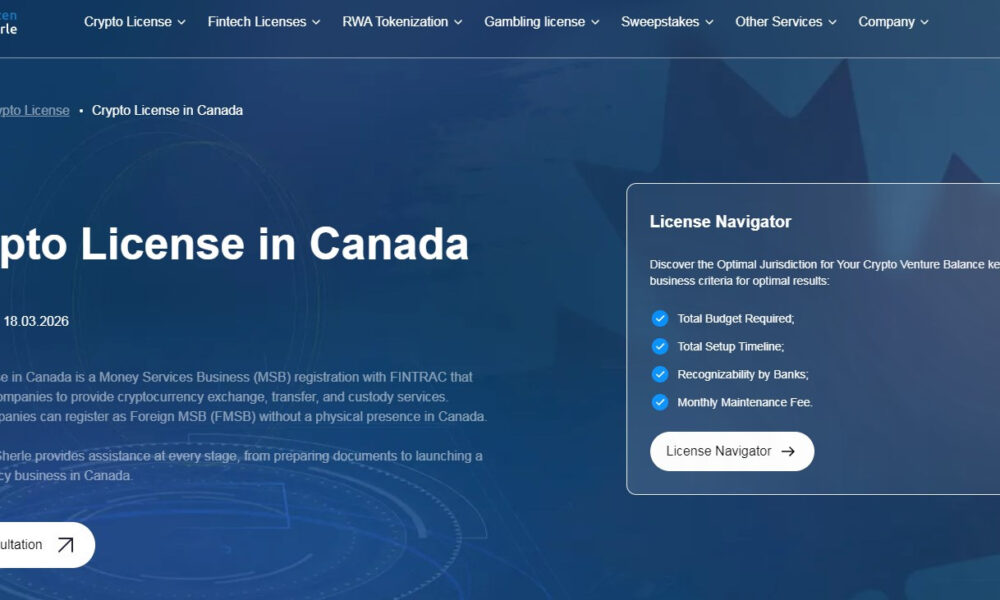
The firm has supported licensing projects across more than 50 jurisdictions. Their Canada practice focuses on MSB registration for crypto exchanges, custodial services, and payment processors. They handle both the federal FINTRAC side and the provincial CSA requirements when securities rules apply.
What sets them apart:
- Built the Crypto License Navigator tool that helps clients pick the right jurisdiction based on budget, timeline, bank accessibility, and monthly costs. Gofaizen & Sherle experts recommend running your business model through this tool before submitting any application.
- They manage the full compliance package: AML/KYC policies, risk assessments, transaction monitoring procedures, and the Travel Rule requirements that FINTRAC enforces for crypto transfers over 1,000 CAD.
- Their legal consultants for crypto licensing handle company formation in Canadian provinces (typically Ontario or British Columbia), bank account setup, and ongoing reporting obligations after approval.
One client on Trustpilot noted their “responsiveness, attention to detail, and ability to navigate intricate legal challenges.” Another highlighted their after-sales support, saying the team set up a dedicated follow-up group and handled post-license queries with “incredible speed.”
Gofaizen & Sherle also offers three service packages for crypto licensing in Canada: Basic (9,800 USD) for existing companies needing application support, Advanced (13,000 USD) including company setup and local director, and Full (15,200 USD) with corporate account support.
Best for: Crypto exchanges, custodial platforms, and tokenization projects needing a specialized crypto licensing firm with boots on the ground in Canada.
2. Lawrange
Lawrange focuses exclusively on Canada MSB licensing. That is all they do. Their website breaks down the entire FINTRAC registration process in plain language, which tells you they have done this work many times before.

They offer legal consulting services for crypto business setup, specifically for Canada. No distractions from other jurisdictions. No split focus. Their team walks clients through the application from start to finish.
What sets them apart:
- They publish detailed guides on Canada crypto regulation, including the distinction between MSB and FMSB status. Foreign companies get the FMSB route, which requires no physical presence in Canada.
- Their crypto lawyers handle the full FINTRAC compliance program: customer identification procedures, transaction monitoring, suspicious activity reporting, and the mandatory independent audit that must happen annually.
- They help with the banking challenge. Many Canadian financial institutions still hesitate with crypto firms. Lawrange knows which banks have opened accounts for their past clients.
- The firm emphasizes that MSB registration costs nothing from the government side. No state fees. The expense comes from building the compliance infrastructure correctly.
Best for: Foreign companies targeting Canada that want a legal crypto consulting firm that does nothing but Canada MSB work.
3. Key2Law
Key2Law operates across multiple jurisdictions but lists Canada as a core licensing destination. Their website shows clear packages for Canada MSB registration alongside their European and offshore offerings.

The firm handles the corporate side first: company registration in the chosen Canadian province, director appointments, and registered address setup. Then they move to the FINTRAC application and compliance documentation.
What sets them apart:
- They offer lawyers for obtaining crypto license who understand both the AML side and the securities side. That matters if your crypto asset gets classified as a security under CSA rules.
- Their team prepares the mandatory compliance officer appointment documentation. FINTRAC requires a designated person responsible for AML/CTF procedures. Key2Law helps clients select and document that role.
- They maintain relationships with payment service providers that work with licensed crypto firms in Canada. Getting the license is one thing. Finding a payment processor afterward is another.
- The firm handles the ongoing obligations: annual compliance audits, reporting updates, and regulatory changes. They do not vanish after the license arrives.
Best for: International crypto businesses that want a legal service to obtain a crypto license from a firm with reach across multiple jurisdictions but specific Canada expertise.
4. Adam Smith
Adam Smith is a crypto license service provider based in Lithuania with global reach. Their website reports over 1,000 successful crypto licenses completed across different jurisdictions. Canada is one of their listed markets.
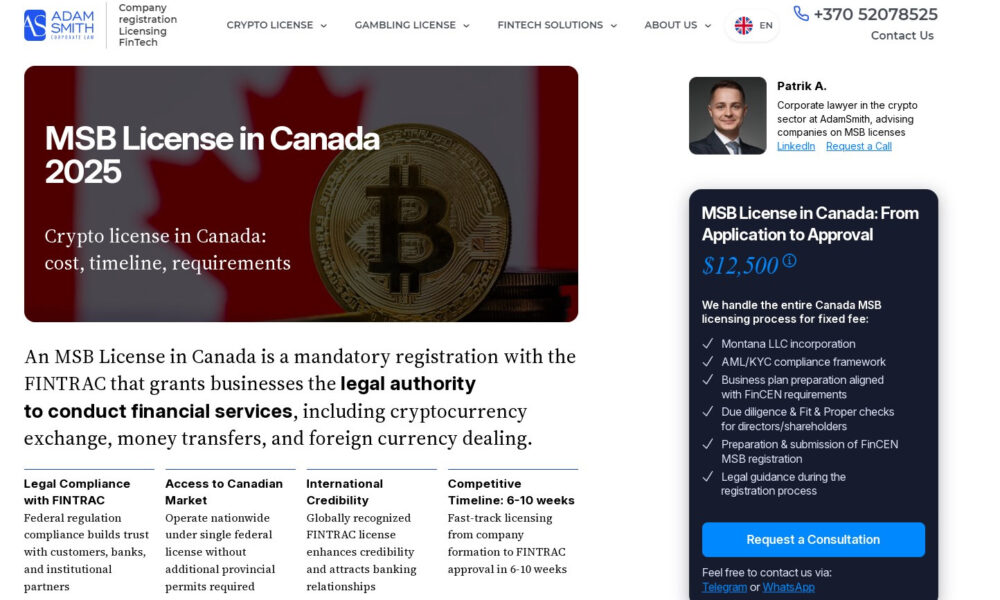
They handle both MSB registration for Canadian operations and FMSB registration for foreign companies serving Canadian customers remotely. Their team covers the entire process: company formation, compliance documentation, and regulator communication.
What sets them apart:
- Their experience volume matters. Having completed thousands of crypto licensing projects means they have seen every regulator question before. They know what FINTRAC wants to see before they ask.
- They provide legal consulting services for crypto business setup that include the appointment of a local AML officer. FINTRAC requires a compliance officer based in Canada for MSB status. Adam Smith helps clients fill that role.
- The firm manages the dual regulatory environment. FINTRAC handles AML. CSA handles securities classification. Their team keeps both in view during the application process.
- They offer post-license compliance support, including the independent audit that FINTRAC mandates every year. That audit is not optional. Adam Smith makes sure it happens.
Best for: European crypto projects expanding into Canada who want a legal consulting firm for crypto business with massive licensing volume behind them.
5. Samson Solutions
Samson Solutions focuses primarily on European crypto licensing, but a client testimonial on their website confirms they have handled Canada MSB registration successfully. One client wrote: “Special thanks to their team for helping us with MSB registration in Canada — everything went smoothly because of their expertise.”
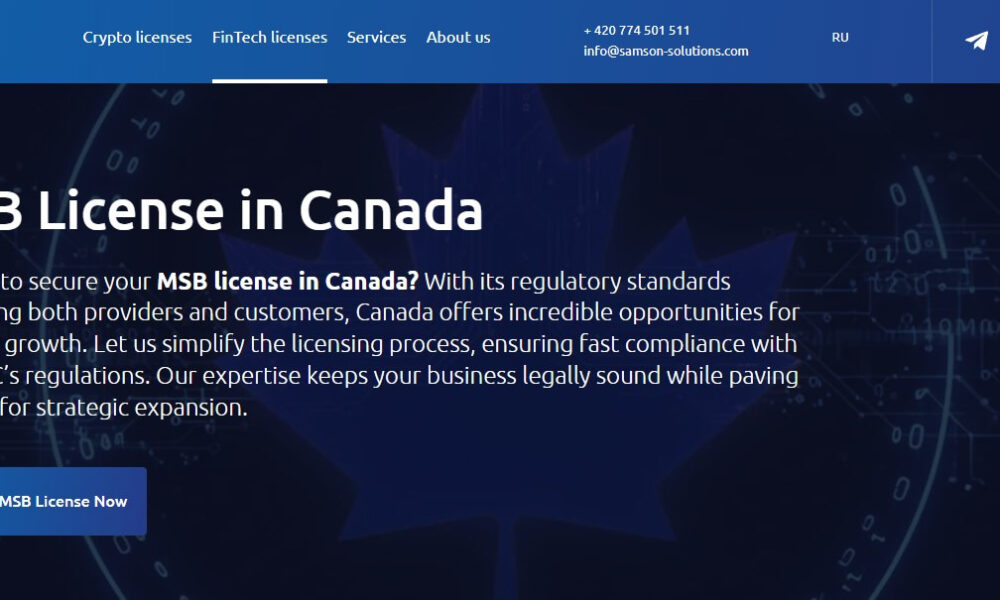
That testimonial comes from Denys at ChaosOTC s.r.o., a real client with a verifiable company. Samson Solutions does not just claim Canada expertise. They have delivered it.
What sets them apart:
- Their European base gives them MiCA experience, which translates well to Canada’s regulatory structure. Both systems emphasize AML compliance and consumer protection.
- They offer legal service to obtain a crypto license with transparent pricing. Their website lists costs for European jurisdictions. Canada pricing is available on request.
- The firm handles the full compliance program: KYC policies, transaction monitoring, risk assessment models, and the reporting procedures FINTRAC requires.
- Their team includes AML officers who understand the Travel Rule implementation. Canada enforces this rule strictly for crypto transfers above the threshold.
Best for: European crypto firms already operating under MiCA who want to add Canada MSB registration without switching to a new specialized legal firm for obtaining crypto license.
FAQ
We get questions about Canada MSB licensing constantly. Here are the ones that come up most often.
What is the difference between MSB and FMSB registration?
MSB applies to companies with a physical presence in Canada. FMSB applies to foreign companies serving Canadian customers remotely. Both register with FINTRAC. Both require the same AML compliance program. The difference is whether you have an office, employees, or agents in Canada.
How long does Canada MSB registration take?
FINTRAC processing averages three to five months. The timeline depends on how complete your documentation is when you submit. Applications with missing policies or unclear business models get delayed. Ready compliance programs move faster.
Do I need a Canadian bank account before applying?
You need proof of banking relationships. FINTRAC wants to see that you have access to the financial system. Some banks in Canada open accounts for licensed crypto firms. Some do not. Your legal firm should know which banks have approved past clients.
What is the Travel Rule, and why does it matter?
FINTRAC requires MSBs to collect and transmit sender and recipient information for crypto transfers above 1,000 CAD. Your compliance system must handle this technically. It is not optional. FINTRAC checks during audits.
What happens after I get the license?
Ongoing obligations start immediately. You must submit suspicious transaction reports. You must conduct an independent AML audit annually. You must update your compliance program when regulations change. You must maintain records for at least five years. The license is the beginning, not the end.
How the Best Firms Handle Post-License Work
Getting the MSB registration approved is step one. The firms that earn long-term trust handle what comes after.
FINTRAC expects quarterly reporting on certain activities. The Travel Rule requires ongoing technical compliance. Annual audits are mandatory, not optional. Regulators update their guidance regularly.
Some firms treat the license as a finish line. They hand over the approval and disappear. Their clients end up scrambling when FINTRAC asks for documentation six months later.
The firms listed here treat the license as a starting point. Their lawyers for obtaining crypto license stay involved. They schedule the first compliance review before the license even arrives. They know FINTRAC will circle back. They want clients ready.
That distinction matters more than the initial application speed. A license you cannot keep is not worth having.
Final Thoughts
Canada offers one of the most accessible paths to crypto licensing among developed nations. No minimum capital. Foreign companies welcome. A regulatory framework that has operated since 2014. Banks that recognize FINTRAC registration.
But accessibility does not mean simplicity. FINTRAC demands real compliance. The Travel Rule requires technical implementation. CSA oversight adds another layer if your assets cross into securities territory.
The firms we covered all deliver MSB registrations. That is the baseline. The difference shows up afterward. Some keep their clients compliant year after year. Some move to the next project and leave clients on their own.
When you pick a legal consulting firm for crypto business, ask about what happens after approval. Ask about annual audits. Ask about regulatory updates. Ask about the Travel Rule.
The best crypto license service provider is the one who treats your license as a long-term responsibility, not a one-time transaction.